
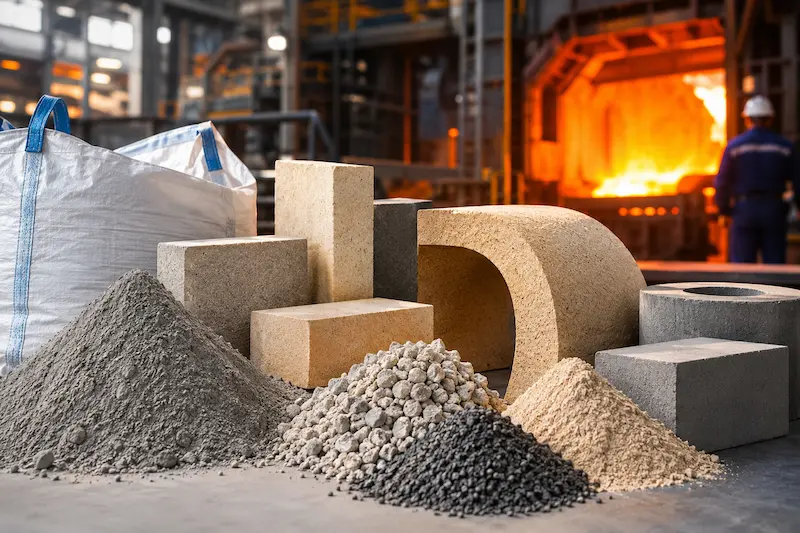
Buying refractory materials in bulk is not simply a matter of finding the lowest price. Before placing a large order, buyers should make sure that the selected refractory material is technically compatible with the furnace, process conditions, installation method, and expected service life. An incorrect bulk purchase can lead to premature refractory failure, unexpected maintenance, production downtime, and significantly higher operating costs.
For steel plants, foundries, cement plants, heat-treatment facilities, and other high-temperature industries, the right purchasing decision requires a combination of technical evaluation, quality control, supplier assessment, logistics planning, and cost analysis. This guide explains the most important factors to check before purchasing refractory materials in bulk.
Why Is Bulk Refractory Purchasing Different?
Refractory materials operate under demanding conditions, including high temperatures, thermal cycling, abrasion, chemical attack, mechanical impact, and contact with molten metals or slag.
When purchasing a small quantity, an incorrect selection may have a limited financial impact. However, when purchasing several tons or an entire production requirement, selecting the wrong material can create a much larger problem.
For example, a castable refractory may appear suitable based on its temperature rating, but if it has insufficient abrasion resistance for a charging area, the lining may deteriorate much sooner than expected.
This is why bulk refractory purchasing should focus on performance and total cost of use, not only the initial purchase price.
1. Identify the Exact Application Before Buying
The first step is to determine exactly where and how the refractory material will be used.
Different industrial furnaces have different refractory requirements. A material used in a steelmaking furnace may not be the right choice for an induction furnace, melting furnace, cement kiln, or heat-treatment furnace.
Even different zones inside the same furnace can require different refractory properties.
Important Information to Identify
- Type of furnace or industrial equipment
- Exact application area
- Normal operating temperature
- Maximum process temperature
- Type of molten material
- Slag or chemical environment
- Level of abrasion and mechanical impact
- Frequency of thermal cycling
- Required lining thickness
- Installation method
The more accurate this information is, the easier it becomes to select the appropriate refractory grade.
2. Review the Technical Datasheet
Before purchasing refractory materials in bulk, always request and review the manufacturer’s technical datasheet.
Depending on the product type, important technical parameters may include:
- Alumina (Al₂O₃) content
- Magnesia (MgO) content
- Bulk density
- Apparent porosity
- Cold crushing strength
- Modulus of rupture
- Permanent linear change
- Abrasion resistance
- Thermal shock resistance
- Maximum service temperature
- Recommended installation conditions
For alumina-based refractory products, for example, Al₂O₃ content is an important specification, but it should not be used as the only purchasing criterion.
Two products with similar alumina content can perform differently because of differences in raw materials, aggregate quality, particle-size distribution, binder system, porosity, and manufacturing process.
3. Do Not Choose Only Based on Price
Price is obviously an important factor in industrial procurement, but the lowest purchase price does not always represent the lowest cost.
A cheaper refractory product may require more frequent replacement, generate higher installation costs, or cause unexpected production interruptions.
When comparing suppliers, consider the total cost of ownership, including:
- Purchase price
- Transportation costs
- Installation costs
- Maintenance costs
- Replacement frequency
- Production downtime
- Labor costs
- Material waste
For example, if a refractory lining costs 15% less but lasts significantly fewer operating cycles, the cheaper product may ultimately be much more expensive.
4. Check Product Quality and Batch Consistency
In bulk purchasing, product consistency is just as important as the quality of an individual sample.
Industrial users often require repeated deliveries over several months. If the properties of one batch differ significantly from another, furnace performance and refractory life may also become inconsistent.
Before placing a large order, ask the supplier about quality-control procedures, raw-material inspection, production controls, and final product testing.
Consider a Trial Order
For critical applications, testing a sample or using a limited quantity before committing to a large purchase can reduce the risk of selecting an unsuitable refractory material.
A successful trial can provide useful information about installation, drying, performance, wear rate, and compatibility with the actual operating environment.
5. Evaluate the Refractory Supplier
The supplier is an important part of the purchasing decision. A reliable refractory supplier should be able to provide more than a product name and a price.
Technical knowledge, consistent supply, product documentation, quality control, and after-sales support can all have a direct impact on the success of a refractory project.
Questions to Ask a Refractory Supplier
- Is this refractory suitable for my furnace application?
- What are the recommended operating conditions?
- What is the difference between available grades?
- What installation method should be used?
- What is the recommended water addition for castables?
- What curing and dry-out procedure is required?
- Can the same grade be supplied consistently?
- How is batch quality controlled?
- What is the expected delivery time for bulk orders?
A supplier that can answer these questions accurately is generally more valuable than one that only competes on price.
6. Calculate the Required Quantity Accurately
Bulk refractory purchasing also requires accurate quantity planning.
The required quantity depends on the dimensions of the application area, lining thickness, product density, installation method, and expected installation losses.
Ordering too little can interrupt installation, while ordering significantly more than required can tie up capital and create unnecessary storage requirements.
For large projects, it is recommended to calculate the theoretical requirement and then add a reasonable allowance for installation waste based on the specific application.
7. Check Packaging and Storage Requirements
Proper packaging and storage are particularly important for powdered and monolithic refractory materials.
Exposure to moisture, unsuitable temperatures, damaged packaging, or prolonged storage under inappropriate conditions may affect certain refractory products.
Before purchasing in bulk, confirm:
- Packaging type
- Recommended storage conditions
- Shelf life
- Protection against moisture
- Handling requirements
- Loading and transportation conditions
Good storage planning becomes especially important when purchasing enough refractory material for several months of production.
8. Confirm Delivery Time and Supply Capacity
For industrial customers, having a reliable supply is often more important than receiving a slightly lower quotation.
If a production line consumes refractory materials continuously, the supplier should be capable of maintaining supply according to the required schedule.
Before signing a bulk purchasing agreement, clarify:
- Current stock availability
- Production capacity
- Lead time
- Delivery schedule
- Minimum order quantity
- Availability of future batches
This is particularly important for large industrial projects where a shortage of refractory material can delay maintenance or furnace operation.
9. Include Transportation in the Final Cost
The price quoted by a refractory supplier may not always represent the final delivered cost.
Transportation, loading, packaging, and delivery distance can significantly affect the total purchasing cost, especially for large and heavy orders.
When comparing quotations, make sure you understand whether the price includes transportation or whether delivery is calculated separately.
A realistic comparison should always be based on the total delivered cost.
10. Clarify Payment and Commercial Conditions
Bulk purchases should have clearly defined commercial conditions before the order is finalized.
Important items include:
- Payment schedule
- Deposit requirements
- Delivery terms
- Order quantity
- Product specifications
- Delivery schedule
- Procedure for handling product discrepancies
Clear documentation helps prevent misunderstandings and gives both the buyer and supplier a reliable reference throughout the transaction.
Why Technical Consultation Matters Before a Bulk Order
In many cases, the biggest purchasing mistake occurs before the quotation stage: the wrong refractory grade is requested in the first place.
Technical consultation can help determine whether the selected product is actually suitable for the operating conditions or whether another grade would provide better performance.
Professional consultation is particularly valuable when:
- The existing refractory lining has failed prematurely.
- The furnace operating temperature has changed.
- The production process has changed.
- A new refractory supplier is being considered.
- The customer wants to reduce maintenance costs.
- Different refractory grades are being compared.
- The application involves severe thermal or chemical conditions.
When requesting technical advice, provide the supplier with as much information as possible about the furnace and its operating conditions.
Common Mistakes in Bulk Refractory Purchasing
Choosing the Cheapest Supplier
Price should be evaluated together with product performance, service life, technical support, and total operating cost.
Comparing Products Using Only One Specification
Looking only at alumina content, magnesia content, or maximum temperature can lead to an incomplete comparison.
Buying Large Quantities Without Testing
For a new application or a new supplier, a controlled trial can reduce the risk of a costly bulk purchase.
Ignoring Installation Conditions
Correct material selection does not guarantee good performance if the product is mixed, installed, cured, or dried incorrectly.
Failing to Plan Future Supply
Industrial customers should consider not only today’s order but also the availability and consistency of future deliveries.
Bulk Refractory Materials from Azarshid Pars
Azarshid Pars Refractory Products provides refractory materials and technical solutions for industrial high-temperature applications.
For bulk purchasing, our approach is based on evaluating the actual application rather than simply recommending a product based on price or a single technical specification.
Whether you require alumina refractory materials, magnesia-based refractories, castable refractory products, refractory bricks, or other industrial refractory products, providing the operating conditions of your furnace can help identify a more appropriate solution.
If you are planning a large refractory purchase, changing your current supplier, or experiencing premature refractory failure, technical consultation before placing the order can help reduce purchasing risk and unnecessary operating costs.
Technical Consultation & Purchasing: +98 913 251 9644
Contact Azarshid Pars and share your furnace conditions and refractory requirements to discuss the most suitable solution for your application.
Final Checklist Before Buying Refractory Materials in Bulk
- Have you identified the exact application?
- Do you know the normal and maximum operating temperature?
- Have you evaluated thermal shock and thermal cycling?
- Have you considered abrasion and mechanical impact?
- Is the refractory chemically compatible with the process?
- Have you reviewed the complete technical datasheet?
- Have you evaluated the supplier’s technical capability?
- Have you checked batch consistency and quality control?
- Have you calculated the required quantity?
- Are packaging and storage conditions suitable?
- Have you confirmed lead time and future supply capacity?
- Have you calculated the total delivered cost?
- Are payment and delivery conditions clearly defined?
Conclusion
Bulk purchasing of refractory materials should be treated as a technical and strategic decision, not simply a price comparison.
The right decision requires evaluating the application, operating temperature, chemical environment, abrasion, thermal shock, mechanical requirements, technical specifications, installation method, product consistency, supplier reliability, logistics, and total cost of ownership.
A refractory material that costs slightly more at the purchasing stage may ultimately be the more economical option if it provides longer service life, fewer repairs, and less production downtime.
Before placing a large order, make sure the selected refractory is designed for your actual operating conditions and that your supplier has the technical capability and supply capacity to support your requirements.
If you need assistance selecting or purchasing refractory materials for an industrial furnace, contact Azarshid Pars Refractory Products for technical consultation.
For technical consultation and bulk refractory purchasing: +98 913 251 9644
Frequently Asked Questions
What is the most important factor when buying refractory materials in bulk?
The most important factor is compatibility between the refractory material and the actual operating conditions of the furnace. Temperature, chemical exposure, abrasion, thermal cycling, and installation conditions should all be considered.
Should I choose the cheapest refractory material?
Not necessarily. The best purchasing decision should consider total cost of ownership, including service life, maintenance, replacement, installation, transportation, and production downtime.
Should refractory materials be tested before a bulk purchase?
For critical applications or when working with a new supplier, a sample or trial order can help verify installation characteristics and practical performance before committing to a large purchase.
What information should I provide to a refractory supplier?
Provide the furnace type, operating temperature, application area, lining thickness, molten material or slag conditions, abrasion level, installation method, required quantity, and previous refractory performance whenever possible.
How can I reduce the risk of a bulk refractory purchase?
Use a clear technical specification, evaluate the supplier, review quality-control procedures, test the product when appropriate, calculate the total delivered cost, and obtain technical advice before finalizing the order.