
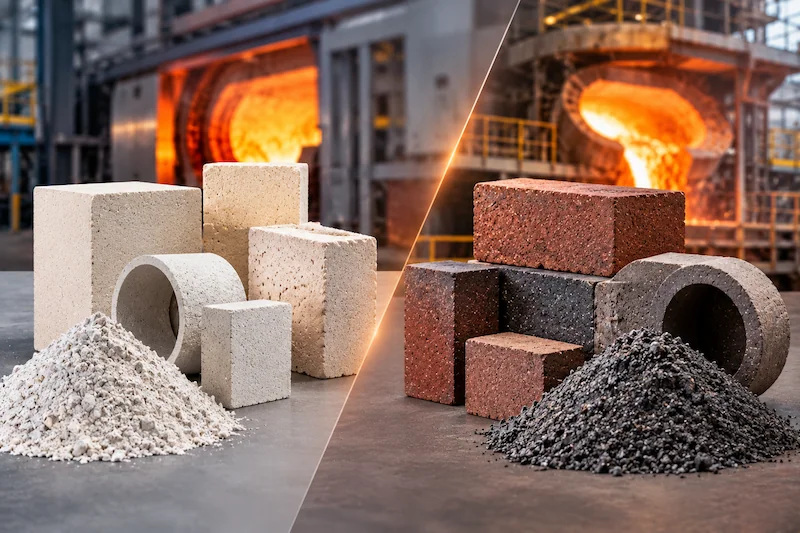
The main difference between magnesia and alumina refractories lies in their chemical composition, resistance to slag, operating conditions, and industrial applications. Magnesia refractories are generally preferred in environments exposed to basic slags, while alumina refractories are used across a wide range of furnaces and industrial processes, depending on their alumina content and service conditions. Choosing the right material requires more than comparing maximum temperature ratings; chemical compatibility, mechanical loads, thermal cycling, installation requirements, and total service-life cost must also be considered.
1. What Is an Alumina Refractory?
Alumina refractories are heat-resistant materials primarily based on aluminum oxide (Al₂O₃). Their properties depend on alumina content, mineral composition, manufacturing method, porosity, and the additives used in the formulation. Products range from fireclay and high-alumina bricks to castables, mortars, and other specialized refractory materials.
As alumina content and formulation change, so do important properties such as refractoriness, resistance to chemical attack, hot strength, abrasion resistance, and thermal shock behavior. Therefore, the term “alumina refractory” covers several grades rather than one material with identical performance characteristics.
Common Applications of Alumina Refractories
- Industrial furnace linings and selected high-temperature processing zones
- Steelmaking and metal-processing equipment, depending on slag chemistry and operating conditions
- Cement, ceramic, and glass-related industrial applications where the selected grade is chemically compatible
- Refractory repairs, castable linings, and burner or heating-system components
High-alumina products are often considered when a combination of high-temperature capability, mechanical strength, and resistance to particular operating conditions is required. However, the correct grade must be selected for the specific process rather than by alumina percentage alone.
Learn more about high-alumina refractory materials and their industrial applications.
2. What Is a Magnesia Refractory?
Magnesia refractories are basic refractory materials primarily based on magnesium oxide (MgO). They are widely used in metallurgical environments where contact with basic slags and other chemically aggressive materials makes basic refractory chemistry advantageous.
Their performance depends on factors such as MgO content, impurities, grain structure, bonding system, porosity, and the presence of additional phases. Magnesia products may also be combined with other materials, such as spinel-forming components, to adjust their properties for particular operating environments.
Common Applications of Magnesia Refractories
- Basic slag zones in steelmaking furnaces and ladles, subject to the specific process conditions
- Selected cement kiln zones where the lining must withstand demanding thermal and chemical conditions
- Non-ferrous metallurgical equipment designed for compatible operating environments
- Industrial furnaces requiring basic refractory chemistry and suitable hot-strength properties
Magnesia refractories are not automatically suitable for every high-temperature application. Their compatibility with the actual slag, atmosphere, operating cycle, and adjacent lining materials must be evaluated before specification.
3. Magnesia vs. Alumina Refractories: Key Differences
The following comparison provides a practical overview. Actual performance varies by product grade, manufacturing quality, furnace design, and operating conditions.
| Comparison Factor | Alumina Refractories | Magnesia Refractories |
|---|---|---|
| Main oxide | Aluminum oxide (Al₂O₃) | Magnesium oxide (MgO) |
| Refractory chemistry | Generally classified as neutral to acidic, depending on composition and behavior | Basic |
| Slag compatibility | Depends on alumina content and slag chemistry | Often advantageous with compatible basic slags |
| Temperature performance | Depends on grade, load, atmosphere, and service conditions | Depends on grade, load, atmosphere, and service conditions |
| Typical applications | Various furnace linings, castables, and high-temperature processing zones | Selected steelmaking, cement kiln, and other basic refractory zones |
| Cost | Varies with grade, alumina content, product form, and supply conditions | Varies with purity, formulation, product form, and supply conditions |
4. Temperature Resistance: Which Material Performs Better?
Neither magnesia nor alumina refractories can be declared universally superior based on temperature resistance alone. A material’s maximum service temperature is only one part of its performance profile. Its ability to withstand load at elevated temperatures, resist creep, maintain dimensional stability, and tolerate repeated heating and cooling can be equally important.
For example, a furnace lining exposed to sustained mechanical loads may require careful evaluation of refractoriness under load and creep behavior. A lining that experiences frequent shutdowns and restarts may require particular attention to thermal shock resistance and permanent linear change.
The correct comparison should use technical data for the exact grades being considered. Relevant parameters include chemical composition, bulk density, apparent porosity, cold crushing strength, refractoriness under load, thermal expansion, and permanent linear change after heating.
5. Chemical Resistance and Slag Compatibility
Chemical compatibility is often the decisive factor when choosing between magnesia and alumina refractories. The interaction between the lining and the slag, molten material, dust, or process atmosphere can cause corrosion, penetration, structural changes, or accelerated wear.
Magnesia-based refractories are commonly selected for suitable basic slag environments. Alumina-based materials may be suitable in many other conditions, but their performance depends on the specific grade and the chemistry of the materials they contact.
Selecting a lining without evaluating slag chemistry can lead to premature failure, even when the material’s rated temperature appears adequate. Where possible, review process data, previous lining performance, wear patterns, and the supplier’s technical recommendations before making a decision.
6. Cost Comparison: Which Refractory Is More Economical?
There is no universal rule that magnesia refractories are more expensive or that alumina refractories are always the lower-cost option. Purchase price depends on raw material quality, purity, grade, product dimensions, manufacturing process, order quantity, packaging, and transportation.
For industrial buyers, the more useful measure is the total cost over the lining’s service life. A lower-priced product may require more frequent repairs or shutdowns, while a higher initial investment may be justified if the selected material offers a longer service life under the actual operating conditions.
When comparing quotations, consider:
- Product grade, chemical composition, and relevant technical specifications
- Expected service life under the intended operating conditions
- Installation, drying, and commissioning requirements
- Repair frequency, downtime, and replacement costs
- Delivery schedule, packaging, and transportation costs
For larger projects, prepare a clear refractory materials RFQ so suppliers can provide accurate and comparable quotations.
7. How to Choose the Right Refractory for Your Furnace
The best choice depends on the furnace zone and the conditions the lining must withstand. Before selecting magnesia or alumina refractory products, evaluate the following factors:
- Operating temperature: Confirm normal and peak temperatures, heating rates, and the duration of each operating cycle.
- Slag and process chemistry: Identify the composition of slags, molten materials, gases, and deposits that may contact the lining.
- Mechanical conditions: Evaluate abrasion, impact, load, vibration, and material movement.
- Thermal cycling: Determine whether the lining experiences frequent starts, shutdowns, or rapid temperature changes.
- Installation method: Confirm whether the application requires shaped bricks, castables, ramming mixes, or another product form.
- Total operating cost: Compare expected service life, maintenance needs, downtime, and initial purchase price.
The same furnace may require different refractory materials in different zones. For example, a high-wear area exposed to basic slag may need a different solution from a section exposed to abrasion, thermal cycling, or a different chemical environment.
Explore our refractory products to understand the available material forms and their potential applications. For cement kiln projects, see our guide to cement kiln refractory bricks.
8. Get Technical Advice from Azarshid Pars
Choosing between magnesia and alumina refractories requires an understanding of the furnace design, process chemistry, operating temperature, and expected service life. Azarshid Pars can help industrial buyers assess their requirements and identify suitable refractory products for their applications.
Before requesting a quotation, prepare the furnace type, application zone, operating temperature, process or slag conditions, required product form, dimensions, and estimated quantity. Providing these details helps make product recommendations and quotations more accurate.
Contact Azarshid Pars for technical consultation and refractory product purchasing.
Phone: +98 913 251 9644
Conclusion
The key difference between magnesia and alumina refractories is their chemical composition and suitability for specific operating environments. Magnesia is often advantageous in compatible basic slag conditions, while alumina refractories serve a broad range of industrial applications. Temperature rating, chemical resistance, mechanical performance, installation requirements, and lifecycle cost should all be considered before choosing a material. The most reliable selection is the one based on the actual service conditions and the technical specifications of the proposed grade.