
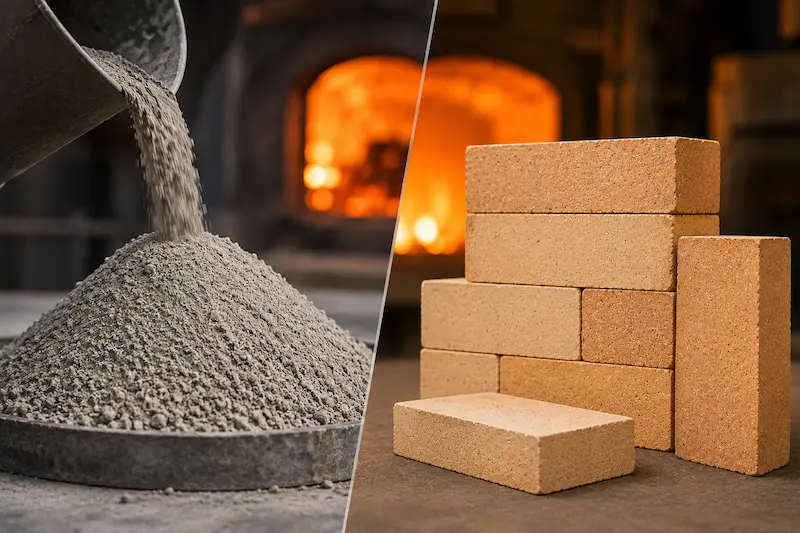
Castable Refractory vs Refractory Brick: Which Choice Reduces Furnace Costs?
In industrial operations, refractory materials are critical components that directly affect furnace efficiency, equipment lifespan, energy consumption, and maintenance expenses. Whether in steelmaking, cement production, petrochemical plants, foundries, or glass manufacturing facilities, selecting the right refractory solution can significantly influence operational profitability.
Among the most common refractory options available today are Castable Refractory and Refractory Brick. Both serve the same primary purpose—protecting industrial equipment from extreme temperatures—but they differ substantially in installation methods, maintenance requirements, thermal performance, and long-term costs.
This article provides a detailed comparison of Castable Refractory and Refractory Brick to help engineers, maintenance managers, and purchasing teams choose the most suitable solution for their operations.
What Is Castable Refractory?
Castable Refractory is a monolithic refractory material supplied in dry form. It is mixed with a controlled amount of water before installation and then poured, cast, or pumped into place.
Once cured and fired, Castable Refractory forms a dense, seamless lining capable of withstanding extreme temperatures and aggressive operating environments.
Modern castables are available in various formulations including:
- Conventional Castables
- Low Cement Castables
- Ultra Low Cement Castables
- Self-Flow Castables
- High Alumina Castables
- Insulating Castables
What Is Refractory Brick?
Refractory Bricks are pre-shaped refractory blocks manufactured under controlled conditions and installed using refractory mortars.
These bricks have been used for decades in industrial furnaces due to their reliability and predictable performance.
Common types include:
- High Alumina Bricks
- Fire Clay Bricks
- Silica Bricks
- Magnesia Bricks
- Insulating Fire Bricks
Installation Comparison
Castable Refractory Installation
One of the major advantages of Castable Refractory is its ability to create a continuous monolithic lining.
- Fewer joints
- Reduced heat leakage
- Suitable for complex geometries
- Fast installation in large projects
- Excellent structural integrity
Because there are fewer joints, opportunities for slag penetration and thermal damage are significantly reduced.
Refractory Brick Installation
Refractory Brick installation requires skilled labor and precise bricklaying techniques.
- Well-established installation methods
- Easy replacement of individual damaged sections
- Strong mechanical stability
- Reliable performance in traditional furnace designs
However, large numbers of joints may increase the risk of thermal losses and chemical penetration.
Thermal Performance Comparison
Both solutions offer excellent resistance to high temperatures when properly selected.
Advanced Castable Refractory products often provide superior thermal uniformity because they eliminate many of the joints found in brick linings.
This seamless structure improves heat distribution and reduces localized stress points.
Mechanical Strength Comparison
Mechanical durability is essential in environments exposed to abrasion, impact, and heavy operational loads.
High-performance Castable Refractories can achieve exceptional compressive strength after proper curing and firing.
Refractory Bricks also offer outstanding mechanical strength but may be vulnerable at mortar joints under certain operating conditions.
Thermal Shock Resistance
Thermal shock resistance determines how well a refractory material survives rapid heating and cooling cycles.
Modern low-cement and ultra-low cement Castable Refractories often demonstrate excellent resistance to thermal cycling.
Depending on composition and application, both materials can perform well, but castables frequently provide better crack resistance due to their monolithic structure.
Maintenance Cost Comparison
Many industrial facilities focus primarily on initial purchase price when selecting refractory materials. However, maintenance expenses often exceed initial installation costs over the lifespan of a furnace.
Castable Refractory linings can reduce maintenance requirements because there are fewer joints and weak points.
In contrast, brick linings may require periodic repairs of damaged bricks and mortar joints.
Downtime and Productivity
Production downtime is one of the largest hidden costs in industrial operations.
Unexpected refractory failures can lead to:
- Production losses
- Higher labor expenses
- Increased maintenance costs
- Safety concerns
- Delayed customer deliveries
Selecting the correct refractory solution can significantly reduce unplanned shutdowns and improve plant productivity.
Energy Efficiency Comparison
Energy efficiency is becoming increasingly important as industrial energy costs continue to rise.
Monolithic Castable Refractory linings often reduce heat loss because they minimize joints and air infiltration pathways.
Improved insulation performance can contribute to lower fuel consumption and reduced operating expenses.
Applications of Castable Refractory
- Steelmaking furnaces
- Induction furnaces
- Cement kilns
- Petrochemical reactors
- Foundries
- Incinerators
- Heat treatment furnaces
Applications of Refractory Brick
- Traditional industrial furnaces
- Glass furnaces
- Ceramic kilns
- Boilers
- Coke ovens
- Rotary kilns
When Should You Choose Castable Refractory?
Castable Refractory is often the preferred choice when:
- Complex furnace geometries are involved.
- Monolithic construction is required.
- Reduced maintenance is a priority.
- Thermal efficiency is critical.
- Fast installation is needed.
When Should You Choose Refractory Brick?
Refractory Brick remains an excellent solution when:
- Traditional furnace designs are used.
- Localized repairs are expected.
- Specific brick-based engineering designs exist.
- Mechanical stability is the primary concern.
How Refractory Selection Impacts Total Furnace Cost
The true cost of a refractory system extends far beyond the purchase price. Engineers should evaluate:
- Installation expenses
- Expected service life
- Maintenance requirements
- Energy consumption
- Downtime risks
- Replacement frequency
In many modern industrial applications, Castable Refractory systems provide lower total lifecycle costs despite a potentially higher initial investment.
Azarshid Pars Refractory Products
Azarshid Pars Refractory Products manufactures and supplies a wide range of alumina-based, silica-based, and specialty refractory solutions for steelmaking, foundry, cement, petrochemical, and thermal processing industries.
The company provides technical consultation, product selection assistance, and customized refractory solutions designed to maximize furnace performance and operational efficiency.
For consultation, product recommendations, pricing inquiries, and purchasing information, contact:
Conclusion
Both Castable Refractory and Refractory Brick offer valuable advantages depending on the application. Refractory Bricks continue to serve many traditional furnace designs effectively, while Castable Refractory systems provide superior flexibility, reduced maintenance, improved thermal efficiency, and seamless installation.
The best choice depends on operating conditions, maintenance strategy, production goals, and long-term cost considerations. By working with experienced refractory manufacturers such as Azarshid Pars, industrial operators can select solutions that improve furnace performance, extend equipment life, and reduce overall operating costs.