
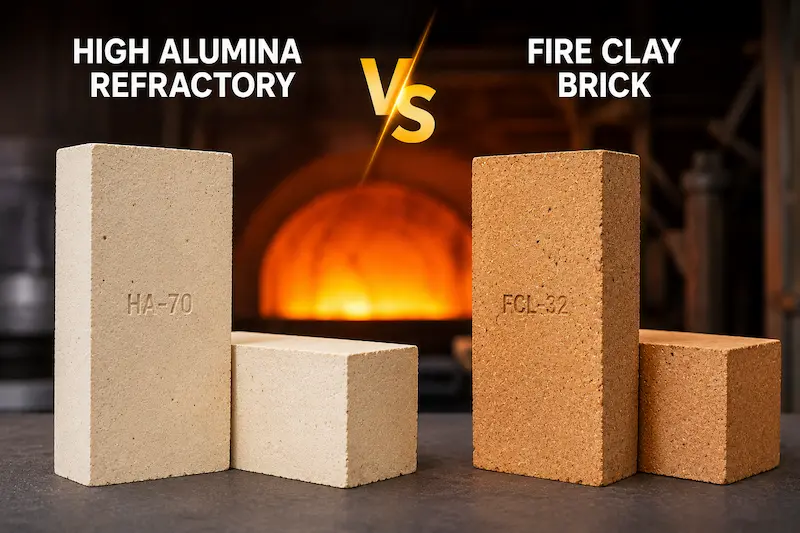
High Alumina Refractory vs Fire Clay Brick: Understanding the Key Differences
Selecting the appropriate refractory material is one of the most important decisions in furnace design and industrial thermal processing. Refractory products directly influence equipment lifespan, operational efficiency, maintenance costs, and overall production quality. Among the most widely used refractory materials are High Alumina Refractory bricks and Fire Clay Bricks.
Although both products belong to the refractory family and are designed to withstand elevated temperatures, they differ considerably in terms of chemical composition, thermal performance, mechanical strength, corrosion resistance, and industrial applications. Understanding these differences is essential for making informed purchasing and engineering decisions.
What is High Alumina Refractory?
High Alumina Refractory refers to refractory products containing a high percentage of aluminum oxide (Al₂O₃). These materials typically contain more than 45% alumina and are designed for demanding industrial environments where extreme temperatures and chemical attacks are common.
As alumina content increases, the refractory generally exhibits improved thermal stability, higher refractoriness, greater mechanical strength, and enhanced resistance to slag penetration and chemical corrosion.
High Alumina Refractory products are commonly used in steel plants, cement kilns, petrochemical facilities, glass manufacturing plants, and metallurgical industries.
What is Fire Clay Brick?
Fire Clay Brick is a traditional refractory material manufactured from fireclay containing silica and alumina. These bricks typically contain between 25% and 45% alumina and offer reliable performance in medium-temperature industrial applications.
Due to their affordability and versatility, Fire Clay Bricks are widely used in boilers, ceramic kilns, incinerators, and general-purpose industrial furnaces.
Chemical Composition Comparison
The most significant distinction between High Alumina Refractory and Fire Clay Brick is their alumina content.
- Fire Clay Brick: Typically 25%–45% Al₂O₃
- High Alumina Refractory: Above 45% Al₂O₃
Higher alumina content enhances resistance to high temperatures, slag attack, and thermal stress. Consequently, High Alumina Refractory products are generally preferred for severe service conditions.
Thermal Resistance Comparison
Industrial furnaces frequently operate at extremely high temperatures. The refractory lining must maintain structural integrity while preventing excessive heat loss.
Fire Clay Bricks provide reliable performance in moderate-temperature environments. However, High Alumina Refractory products can withstand significantly higher operating temperatures.
- Fire Clay Brick: Approximately 1400°C to 1600°C
- High Alumina Refractory: Up to 1750°C and beyond
This difference makes High Alumina Refractory the preferred solution for steelmaking and other high-temperature industries.
Mechanical Strength Comparison
Mechanical strength is critical in environments where refractories are exposed to heavy loads, abrasion, and mechanical stress.
High Alumina Refractory products generally exhibit superior cold crushing strength and abrasion resistance compared to Fire Clay Bricks. This characteristic contributes to longer service life and lower maintenance requirements.
Resistance to Chemical Attack
Industrial furnaces often contain molten metals, slags, gases, and aggressive chemicals that can degrade refractory linings.
High Alumina Refractory materials offer enhanced resistance to chemical corrosion and slag penetration. Fire Clay Bricks, while suitable for many applications, may experience accelerated wear in highly aggressive environments.
For steelmaking, non-ferrous metallurgy, and petrochemical processing, High Alumina Refractory products typically provide superior long-term performance.
Thermal Shock Resistance
Thermal shock occurs when refractory materials experience rapid temperature fluctuations. Repeated heating and cooling cycles can cause cracking and structural damage.
Both materials provide reasonable thermal shock resistance, but properly engineered High Alumina Refractory products often demonstrate improved durability under severe thermal cycling conditions.
Service Life Comparison
One of the primary factors influencing refractory selection is expected service life.
Due to their higher resistance to heat, abrasion, and chemical attack, High Alumina Refractory products generally last longer than Fire Clay Bricks in demanding industrial applications.
Although the initial investment may be higher, longer operational life often results in lower total ownership costs.
Cost Comparison
Fire Clay Bricks are generally less expensive and are frequently selected for applications where operating temperatures and chemical exposure are relatively moderate.
High Alumina Refractory products typically command a higher purchase price because of their superior raw materials and manufacturing requirements.
However, many industrial operators find that reduced maintenance costs and longer service intervals justify the higher upfront investment.
Applications of Fire Clay Brick
- Ceramic kilns
- Boilers
- General industrial furnaces
- Incinerators
- Brick manufacturing kilns
- Medium-temperature processing units
Applications of High Alumina Refractory
- Steelmaking furnaces
- Cement rotary kilns
- Petrochemical plants
- Glass manufacturing furnaces
- Foundries
- Metallurgical processing facilities
- High-temperature industrial reactors
Which Refractory Should You Choose?
The correct choice depends on operating conditions, temperature requirements, chemical exposure, maintenance objectives, and budget considerations.
If your process involves extremely high temperatures, aggressive slags, or severe operating conditions, High Alumina Refractory is generally the superior solution.
For moderate-temperature applications where cost efficiency is the primary concern, Fire Clay Brick may provide satisfactory performance.
Azarshid Pars Refractory Products
Azarshid Pars Refractory Products manufactures and supplies a comprehensive range of alumina-based and silicate refractory solutions for steel, cement, foundry, petrochemical, and industrial furnace applications.
With a focus on product quality, technical expertise, and customer support, Azarshid Pars helps industrial operators select refractory solutions that maximize performance and minimize operational costs.
For technical consultation, product recommendations, pricing information, and purchasing inquiries, contact:
Conclusion
Both High Alumina Refractory and Fire Clay Brick play important roles in industrial thermal processing. While Fire Clay Bricks remain a cost-effective option for moderate applications, High Alumina Refractory products deliver superior thermal performance, chemical resistance, mechanical strength, and operational lifespan.
Choosing the right refractory material can significantly improve furnace efficiency, reduce maintenance costs, and increase overall productivity. Consulting with experienced refractory manufacturers such as Azarshid Pars ensures that industrial facilities select the most suitable solution for their specific requirements.