
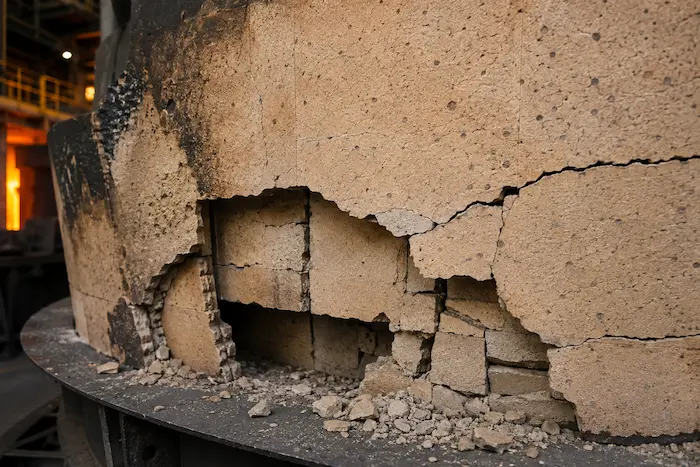
Is your refractory lining cracking, spalling, eroding, or failing much earlier than expected? Replacing the damaged lining with the same material may not solve the problem. In many industrial furnaces, premature refractory failure is caused by incorrect material selection, thermal shock, chemical attack, poor installation, improper dry-out, mechanical wear, or unsuitable operating conditions. Identifying the root cause before the next repair can help reduce downtime, maintenance costs, and repeated lining failures.
A refractory lining is a critical part of any high-temperature industrial system. When it begins to fail, the problem can quickly extend beyond the refractory itself. Heat loss may increase, furnace efficiency can decline, production may be interrupted, and in severe cases, damage to the furnace shell or other equipment may occur.
This guide explains the 7 most common causes of refractory lining failure, the warning signs to look for, and practical ways to prevent premature damage. If your furnace lining has already started to crack or deteriorate, this article can also help you identify which operating or material-related factors should be reviewed before ordering replacement refractory materials.
Why Does a Refractory Lining Fail Earlier Than Expected?
Refractory lining life depends on much more than maximum temperature resistance. A refractory material may perform well at high temperatures but still fail prematurely because it is exposed to aggressive slag, repeated thermal cycling, abrasion, mechanical impact, or incorrect installation.
For this reason, refractory failure should never be analyzed by looking at only one property or one operating condition. The location, appearance, and timing of the damage can provide important clues about the root cause.
For example, network cracking may indicate thermal stress, localized erosion may suggest chemical attack or excessive material flow, and spalling can be related to thermal shock, moisture, or poor installation. A proper failure analysis helps prevent the same problem from being repeated after relining.
For a broader overview of refractory selection, you can also link to your article about Refractory Materials for Industrial Furnaces.
1. Incorrect Refractory Material Selection
One of the most common reasons for premature refractory lining failure is selecting a material based on only one factor, such as maximum temperature rating or initial purchase price.
In reality, the best refractory for an industrial application must match the complete operating environment. Two furnaces may operate at similar temperatures but require completely different refractory solutions because of differences in slag chemistry, molten metal, atmosphere, thermal cycling, abrasion, or installation method.
Common Material Selection Mistakes
- Selecting refractory only by maximum service temperature
- Ignoring slag or chemical composition
- Using the same refractory for different furnace zones
- Choosing the lowest-cost product without evaluating service life
- Ignoring thermal shock and mechanical stress
- Using a material designed for a different application
For example, a high-temperature refractory may not be the best choice if the main cause of failure is severe slag attack or abrasion. Similarly, a material with excellent chemical resistance may still crack if it cannot withstand frequent temperature changes.
How to Prevent It
Before selecting a refractory product, review the furnace type, operating temperature, maximum temperature, thermal cycle, process atmosphere, chemical environment, mechanical load, and installation method.
In applications where alumina content and high-temperature performance are important, different High Alumina Refractory solutions may be considered. However, the final selection should always be based on the actual operating conditions of the equipment.
2. Thermal Shock and Rapid Temperature Changes
Thermal shock occurs when a refractory lining experiences a rapid increase or decrease in temperature. Because different parts of the lining may expand or contract at different rates, internal stress develops inside the refractory structure.
If this stress exceeds the material’s ability to absorb it, cracks can form. Repeated thermal cycling may then cause small cracks to grow, leading to spalling, material loss, and eventually major lining failure.
Common Signs of Thermal Shock
- Multiple irregular cracks on the refractory surface
- Spalling or flaking of the lining
- Pieces of refractory separating from the hot face
- Premature failure after frequent heating and cooling cycles
- Damage concentrated in areas exposed to rapid temperature changes
How to Prevent Thermal Shock
Heating and cooling should be controlled whenever possible. Rapid furnace startup, sudden shutdown, charging cold materials into a very hot furnace, or exposing a hot lining to cold air or water can significantly reduce refractory life.
For equipment with frequent thermal cycling, refractory materials with appropriate thermal shock resistance should be selected. A controlled heating schedule is particularly important after installation or repair.
3. Improper Dry-Out and Initial Heating
Improper dry-out is a major cause of failure, especially in Castable Refractory linings. After installation, moisture must be removed gradually and in a controlled manner.
If the temperature rises too quickly, water trapped inside the lining can turn into steam and create internal pressure. This may lead to cracking, explosive spalling, structural weakness, or localized damage.
A Typical Failure Scenario
Imagine that a damaged section of an industrial furnace is repaired with a new castable refractory. To reduce production downtime, the furnace is heated too quickly. Moisture inside the newly installed lining does not have enough time to escape safely. As temperature increases, steam pressure builds inside the refractory and weakens or damages the structure.
How to Prevent Dry-Out Problems
- Follow the manufacturer’s installation instructions
- Use the correct water ratio during mixing
- Allow sufficient curing time before heating
- Follow a controlled dry-out and heating schedule
- Pay special attention to thicker lining sections
- Avoid accelerating the process simply to shorten downtime
Reducing dry-out time may appear to save production time in the short term, but a damaged refractory lining can result in much longer and more expensive downtime later.
4. Chemical Attack from Slag, Molten Metal, or Process Gases
Chemical attack is one of the leading causes of refractory erosion in steelmaking, foundries, and other high-temperature industries. Slag, molten metal, dust, vapors, and process gases can react with the refractory structure and gradually reduce its thickness and strength.
Chemical compatibility is therefore a key part of refractory selection. A material that performs well in one process may fail quickly when exposed to a different slag chemistry or furnace atmosphere.
Warning Signs of Chemical Attack
- Localized erosion or thinning of the lining
- Changes in refractory texture or appearance
- Deep penetration of process materials
- Damage concentrated around the slag line or molten material contact area
- Repeated failure in the same furnace zone
How to Reduce Chemical Attack
Analyze the chemical environment before selecting the refractory. Important factors include slag composition, metal type, process atmosphere, temperature, and contact time.
In steelmaking applications, refractory selection may vary significantly between different furnace zones and process stages. For related applications, you can internally link to articles about Tundish Refractory and Steelmaking Applications and other steelmaking refractory solutions.
5. Poor Installation and Workmanship
Even a high-quality refractory product can fail if it is installed incorrectly. Installation quality directly affects density, porosity, structural strength, and overall lining performance.
For refractory bricks, poor joint design or incorrect brick placement can create weak points. For castables, excessive water, poor mixing, or incorrect vibration can increase porosity and reduce strength. For ramming materials, uneven compaction can result in inconsistent lining density.
Common Installation Errors
- Adding too much water to castable refractory
- Insufficient or inconsistent mixing
- Improper vibration during installation
- Uneven compaction of ramming materials
- Incorrect lining thickness
- Poor surface preparation before repair
- Ignoring curing and dry-out requirements
In induction furnace applications, the installation quality of Dry Ramming Mass can directly affect lining uniformity and service life. The material should be compacted correctly and consistently throughout the lining.
6. Excessive Mechanical Wear and Abrasion
Not all refractory damage is caused by temperature or chemistry. In many industrial applications, the lining is exposed to abrasion, impact, vibration, and continuous material movement.
Areas such as charging zones, furnace floors, material flow paths, and locations exposed to mechanical equipment may experience much faster wear than other parts of the lining.
Where Mechanical Damage Often Occurs
- Material charging areas
- High-flow zones
- Furnace floors and impact areas
- Molten metal flow paths
- Areas exposed to repeated scraping or vibration
How to Reduce Mechanical Wear
When analyzing refractory failure, do not focus only on chemical composition. The exact location and shape of the damaged area are important.
If the same area repeatedly fails while the rest of the lining remains in good condition, the problem may be related to mechanical impact, material flow, local design, or insufficient lining thickness. In these cases, changing only the refractory material may not completely solve the problem.
7. Improper Furnace Operation and Poor Maintenance
Some refractory failures develop gradually during normal operation. Running equipment outside its intended operating range, ignoring early warning signs, or delaying repairs can turn a small damaged area into a major lining failure.
A small crack or localized area of erosion may be manageable when detected early. If it continues to grow, however, it can expose deeper layers and require a much larger repair.
Why Regular Inspection Matters
- Early detection of cracks and spalling
- Monitoring localized erosion
- Comparing actual lining life with expected service life
- Identifying repeated failure patterns
- Planning maintenance before emergency shutdowns occur
A Practical Maintenance Approach
Keep records of where and when refractory damage occurs. If lining life suddenly decreases, compare the failure with recent changes in furnace operation, production volume, temperature, raw materials, slag chemistry, or installation procedures.
This information can be extremely useful when evaluating the root cause and selecting a replacement refractory solution.
How to Identify the Root Cause of Refractory Lining Failure
Refractory failure should not be diagnosed by assuming that one factor is always responsible. A proper evaluation should consider the material, installation process, operating history, and visible damage pattern together.
Refractory Failure Analysis Checklist
- Where exactly did the damage occur?
- Is the failure cracking, spalling, erosion, abrasion, or collapse?
- How long after installation did the damage appear?
- Has the operating temperature changed?
- Have the raw materials, slag, or process conditions changed?
- Was the dry-out procedure followed correctly?
- Is the same failure pattern repeating in the same area?
- Was the refractory installed according to the recommended procedure?
Answering these questions before ordering replacement materials can help prevent the same failure from occurring again.
The Costly Mistake: Replacing the Lining Without Finding the Root Cause
One of the most expensive mistakes is replacing a failed refractory lining with exactly the same material without investigating why the previous lining failed.
If the real problem was thermal shock, chemical attack, poor installation, or an incorrect dry-out procedure, repeating the same product and the same process may simply reproduce the same failure.
Before purchasing replacement refractory materials, it is better to review the furnace conditions and failure history. In many cases, a change in material selection, installation method, operating practice, or maintenance strategy can provide a longer service life than simply choosing a more expensive product.
Conclusion: Find the Cause Before Replacing the Refractory Lining
Premature refractory lining failure is usually linked to one or more of these seven factors: incorrect material selection, thermal shock, improper dry-out, chemical attack, poor installation, mechanical wear, and unsuitable furnace operation or maintenance.
The most effective way to extend refractory lining life is not simply to purchase a higher-priced product. Long-term performance depends on selecting the right material for the application, installing it correctly, following proper heating procedures, and monitoring actual operating conditions.
If your refractory lining is cracking, spalling, eroding, or failing earlier than expected, investigate the root cause before placing your next order. A technical review can help you avoid repeated failures and reduce unnecessary furnace downtime.
Technical Consultation and Refractory Supply from Azarshid Pars
Azarshid Pars Refractory Products supplies refractory solutions for industrial applications and can assist customers in evaluating operating conditions, identifying application requirements, and selecting suitable refractory materials.
To receive technical consultation or discuss your refractory requirements, prepare the following information when possible:
- Furnace or equipment type
- Operating and maximum temperature
- Application and process conditions
- Type of molten metal, slag, or chemical environment
- Current refractory material and failure pattern
- Required quantity and destination country
For technical consultation and refractory product inquiries, contact Azarshid Pars:
+98 913 251 9644
Before replacing a failed refractory lining, identify the reason it failed. The right technical decision can help reduce downtime, maintenance costs, and repeated refractory damage.
Frequently Asked Questions About Refractory Lining Failure
What is the most common cause of refractory lining cracks?
Thermal shock is one of the most common causes, but cracks can also result from improper dry-out, poor installation, mechanical stress, or incorrect refractory selection. The location and pattern of the cracks should be evaluated before determining the root cause.
Does a more expensive refractory always last longer?
No. A higher-priced refractory may still fail prematurely if it is not compatible with the actual furnace conditions or if installation and operation are incorrect. Correct product selection is more important than price alone.
How can I increase refractory lining life?
Select the refractory based on actual operating conditions, follow proper installation and dry-out procedures, avoid rapid temperature changes, control chemical attack, and inspect the lining regularly for early signs of damage.
What information should I provide when requesting a refractory recommendation?
Providing the furnace type, operating temperature, process conditions, chemical environment, current refractory material, failure pattern, dimensions, required quantity, and delivery destination can help a supplier provide a more accurate technical recommendation.